Showing posts with label Alice Mbayahi. Show all posts

Thursday, 8 May 2014

LEARNING FROM OUR PAST AND MOVING FORWARD: IDF Conducts Annual Review and Planning Meeting.


IDF staff on 6th and 7th May 2014 held their annual review and planning meeting at Imperial Resort Beach Hotel. The purpose of the meeting was to review past progress and plan for the year 2014/2015. Ten staff (5 female and 5 men) participated in this meeting. During the meeting, staff reflected on the past interventions and results realized from them. They also planned what would be done in the coming year. Among others, the Executive Director Mr. Davis Ddamulira took the staff through where IDF is coming from, with particular focus to the challenges encountered, and the major growth and shifts.
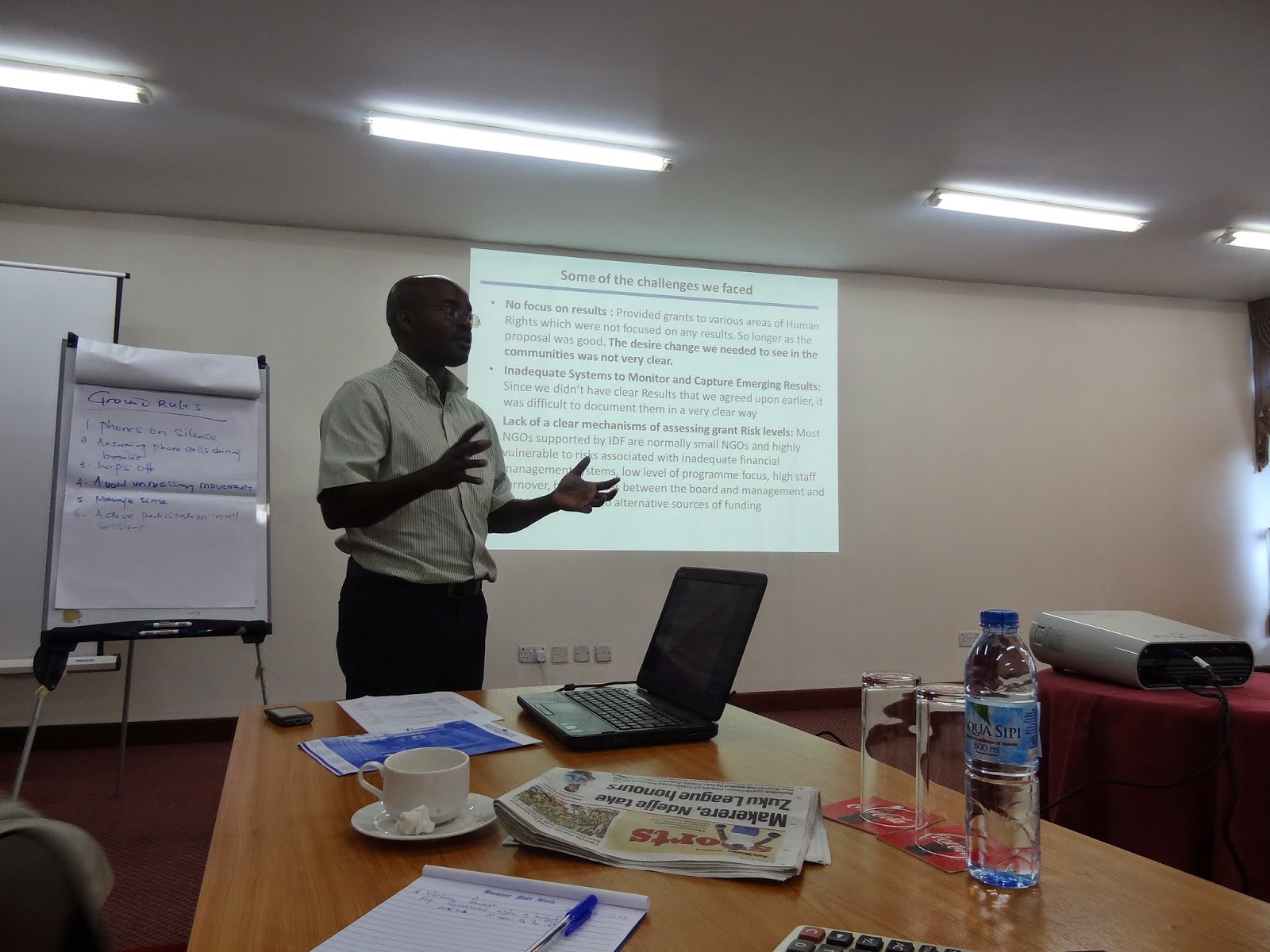
 
Davis Ddamulira presenting at the meeting


Mr. Davis noted that IDF had come along way and is steadily getting better in its operations. He challenged the staff to master their Key result areas such that they can continuously contribute to the IDF goals, objectives and mission.

Andrew presenting at the meeting

In a related development, the Program Results Manager, Andrew Gidudu took the participants through the IDF overall progress; that is, the milestones registered in the year 2013/2014. This helped in reminding the staff on how much they had achieved, the enabling factors and what areas needed more attention- either strengthening or consolidating.
Andrew re-echoed the IDF’s mandate/purpose “contributing to the reduction of human rights violation incidences and bad governance in uganda”, saying whatever , grantees and staff do as individuals or a team should at all times be aimed at this.
Flavia presenting at the meeting
This session was followed by several other sessions during which Program Unit Heads (Andrew Gidudu-for Results Unit, Nyongereza Flavia-for Finance and Phiona Tumukunde for Sarah Nankya- Support Unit) presented  unit progress reports, work plans and budgets for discussion and amalgamation into single working documents- (IDF 2014/2015 Budget and Work plan).
Staff clarify some issues at the meeting
 
Program Results Unit staff harmonizing their work plan and budget
 
Program Support unit and Finance staff  harmonizing their work plans&budgets
Key outputs from the meeting were, a compiled work plan and budget for the year 2014/2015 and enhanced understanding on IDF’s interventions and strategies in the next financial year. 
Summing up the meeting, the IDF Executive Director thanked staff for their patience and active participation in the two days meeting. He encouraged staff to stick to the developed work plan and budget for the intended results to be achieved. He wished everybody safe journeys back home.


Tuesday, 1 April 2014

HIGHLIGHTS FROM IDF’S 2013 -2018 STRATEGIC PLAN


Being the first of its kind in Uganda pioneering a new grant focus on small and medium organizations in the Central, Western, Eastern and Northern parts of Uganda, IDF’s goal in the next five years is to transition into a highly efficient and transparent grant making institution for small and medium-sized organizations working on human rights and good governance issues at local level and a grant manager of choice for funding partners aiming at enhancing protection, fulfillment and observance of human rights and good governance in Uganda.
In the bid to achieve the different strategic objectives stipulated in it’s strategic plan, IDF will build upon its achievements, address highlighted challenges and also transform into a Results-Oriented Centre for Excellence for grant making to small and medium sized organizations pursuing human rights observance and good governance in Uganda. 

It should be noted that the formulation of the IDF strategy is hitched on several lessons from previous implementation and that the five year transformation of IDF will be along three thematic lines; the clarity on IDF’s niche, scope and development goals of IDF support-Under this IDF’s clientele will be the afore mentioned small and medium sized CSOs (Faith based, media and Non Government organizations). They will be serviced through technical, institutional and grants support to enhance observance, protection and fulfillment of human rights. The second aspect of transformation shall be the heighted focus on results and learning. These results will be around four areas; competent and vigilant public monitoring of human rights and governance in the community, target CSOs empowered to monitor compliance to human rights and good governance norms and provide rapid response to victims of violations, new frontiers for the protection and observance of human rights at local level opened up and promoted and an efficient, effective, transparent IDF grant making structure responsive to strategic needs. Lastly will be institutional growth, being an institution in transition, IDF will be creative, innovative, flexible and seek to open new frontiers through generation of new knowledge at local levels. In the same vein will develop performance plans to direct and focus its resources to relevant target areas.

The IDF theory of change is that small and medium funded CSOs working at the individual, community and district level, will be able to mobilize and bring out more cases of human rights violations reported and attended too, knowledgeable and active citizenry, thus further contributing to reduction of human rights violations incidences and poor governance, local policies and systems that support the promotion and protection of human rights and good governance. These combined are expected to result in responsive, accountable local governments to human needs and accountability demands by citizens and reduction of violations of human rights in communities and households.

Cognizant of the dynamic working environment IDF conducted a situation analysis from which it learnt of the different limitations, existing challenges in the work of human rights and governance and those risks that are likely to hamper the successful implementation of it’s strategic plan; they include; low level of rights awareness among communities, low level of primary mobilization of communities by small and medium sized organizations, less visible public activism at the local level, inadequate, slow out of pace response of duty bearers and of course the internal and external challenges facing the small and medium CSOs. As a measure several strategic interventions to these challenges have been developed and are to be implemented along the five years journey. For instance, IDF will invest heavily in raising public rights consciousness, pursue and adopt collaborative approaches with partners in pursuit of its objectives to mitigate the slow duty bearer response and adopt a facilitative yet firm stand to ensure that all grant recipients’ projects are both relevant and honest to community needs.  

On the whole the purpose of this plan is to ensure value addition to IDF’s work. The four value addition areas shall include; building civic competence through “grass rooting’ human rights and the demand for good governance among the public in Uganda particularly the vulnerable and disadvantaged populations; to enhance community mobilization, public activism and access to recourse/redress mechanism; and to open up and promote new frontiers for the protection and observance of human rights at the sub-national level.

Conclusively IDF’s strategic plan shall provide a broad, strategic direction that will direct the growth and set the development agenda for the next five years. And its effective implementation shall be fundamental to the realization of the long term vision of the National development plan of Uganda to foster a rights based approach to national development to promote economic growth, employment and prosperity. The same plan has been designed to contribute to the strategic objectives of IDF’s partners.